

Join the Kiwis who are hatching their tomorrow and have invested more than $2 billion with Hatch.
IPO open season 🦆
Bad time to be a game bird, great time to school up on IPOs. Labelled ‘Megacap IPOs’ by MSCI, several large, venture-backed companies could be going public, and have the potential to reshape the markets.
Leading the charge, SpaceX has officially filed to go public, setting up what could be one of the largest IPOs in history. AI heavyweights Anthropic and Open AI are reportedly preparing to list publicly late this year or 2027. Finnish smart ring maker Oura – nearing 5 million paid members – is also reported to have confidentially filed.
Oura could join a growing list of European-founded companies like On Running (ONON), and Amer Sports (AS) giving the finger to home markets in favour of US listings. Some analysts point to the scale and liquidity of the NYSE and NASDAQ as the draw. 👈
This is no decoy – May has already delivered some noteworthy listings. AI infrastructure company Cerebras Systems (CBRS), backed by OpenAI CEO Sam Altman, started trading on 14 May. Can this new player carve out market share from GPU giant NVIDIA (NVDA)?
Enhanced Group (ENHA), the company behind the Peter Thiel-backed Enhanced Games went public via SPAC on May 8, and has since dropped just over 44%. For an event promising world-beating performances, early returns feel… less superhuman. Two-time Olympic medallist Fred Kerley after running clean and pocketing a US$250K prize summed it up: ‘Man, they need to do better than that’ 🫳 🎤
Sitting ducks — AI isn’t missing this shot
AI is fast becoming the rationale behind sanctioned mass culls across both the public and private sectors. In the US, tech companies are cutting deep while reinvesting in automation, hedging against a future where some of their products could risk being obsolete.
Meta (META) is laying off around 10% of its 78,000 workforce, and shifting 7,000 employees into AI-focused roles. Block (XYZ) has also cut 40% of its workforce as AI tools replace entire workflows.
Efficiency, or survival mode? Productivity software company Atlassian (TEAM) slashed around 1,600 roles in March, while doubling down on AI, while Intuit (INTU) has trimmed about 3,000 jobs. Both stocks are down heavily year-to-date. Investors aren’t just reacting to cost cuts — they’re questioning which products still have a moat in an AI-first world.
Must be just happening overseas or something? Yeah nah. Here on the home pond, the New Zealand government plans to cut 8,700 public sector roles over the next three years, alongside a push to ‘increase the use of AI and other digital tools’ to drive savings. Entry-level roles are already feeling it, with the unemployment rate for 15 - 24 year-olds at around 15%.
Same story everywhere: do more with less… or get replaced. 🤖
Data Centres 🌏
AI isn’t just reshaping jobs, it’s rebuilding the market underneath them. We’ve talked about AI’s demand for memory – another thing it needs is powerful data centres to handle massive workloads around the clock.
Case in point: Utah’s proposed Stratos Hyperscale Data Centre. Backed by Shark Tank’s Kevin O’Leary, the project spans a staggering 160 square kilometres — roughly the size of the Waitākere Range Regional park. At full noise, it’s expected to draw up to 9 gigawatts (GW) of power. NZ’s demand peaks on our coldest winter evenings at 7.5 GW – for the entire country.
Data centres create thousands of jobs, and can help the US stay competitive in AI and cloud computing. But it’s not all upside. Communities are starting to push back, with concerns about emissions, water scarcity, and environmental strain. Across the ditch, similar concerns are emerging as Australia’s data centre boom puts pressure on already stretched resources.
Who's paying rent on this? 🏠 The Stratos project is being pitched to cloud service providers ‘hyperscalers’ like Amazon’s (AMZN) AWS, Alphabet’s (GOOG) Google Cloud, Microsoft (MSFT) Azure, and Oracle (ORCL), have the scale and the means to pay a 9GW power bill, but tenants are still TBC.
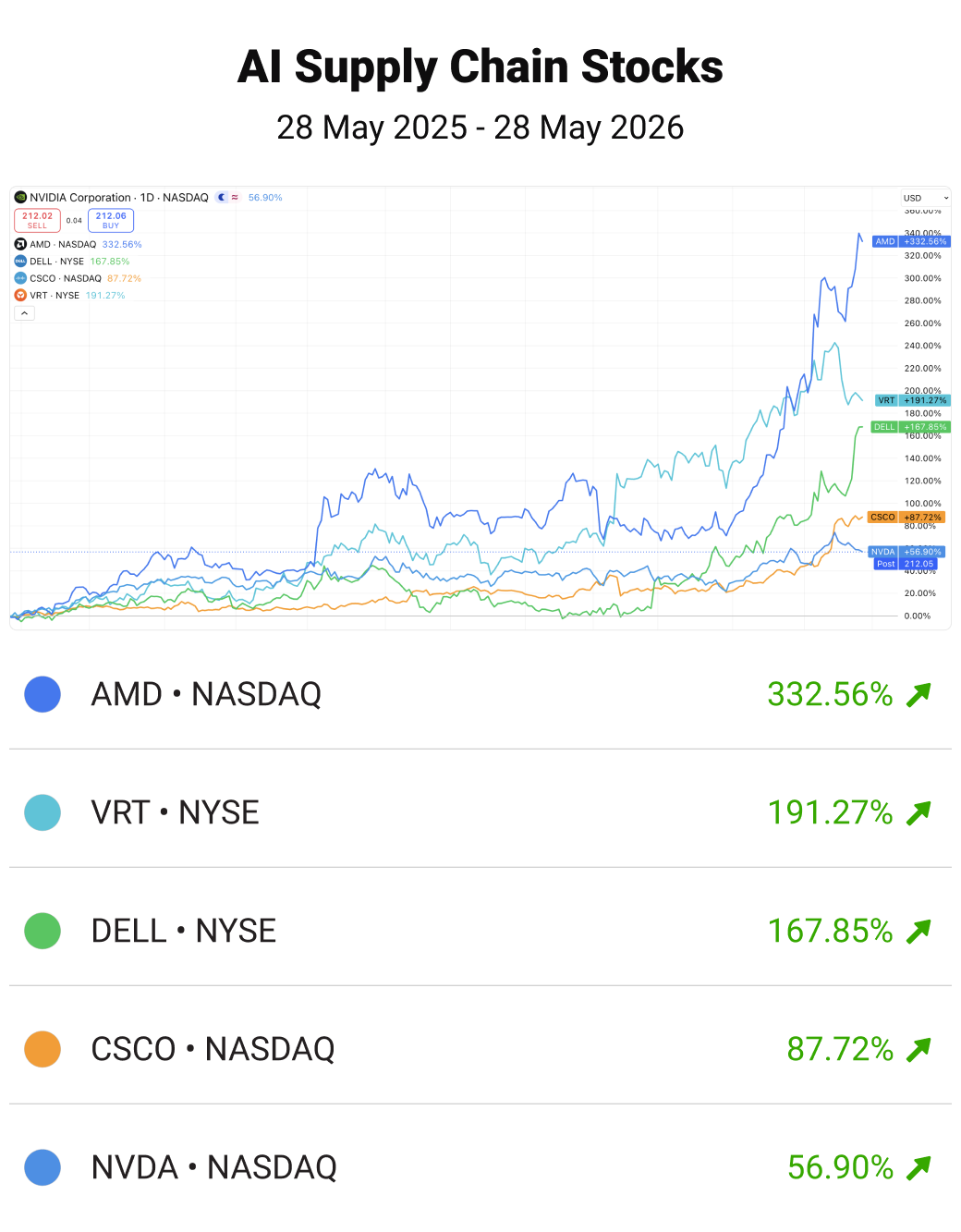
Building and running these AI factories pulls in companies across the market. Companies like NVIDIA (NVDA) and Advanced Micro Devices (AMD) can supply the chips, Dell (DELL) might build the servers, Cisco (CSCO) handles the networking, while companies like Vertiv (VRT) keep everything powered and cool. Then you’ve got landlords like Equinix (EQIX) and Digital Realty Trust (DLR) renting out the space. Different sectors, same trade—selling picks and shovels in the AI gold rush.
IPOs, layoffs, and data centres: Is AI just a trend, or a full market reset?
Read more: AI Demand is eating the world

We’re not financial advisors and Hatch news is for your information only. However dazzling our writing, none of it is a recommendation to invest in any of the companies or funds mentioned. If you want support before making any investment decisions, consider seeking financial advice from a licensed provider. We’ve done our best to ensure all information is current when we pushed ‘publish’ on this article. And of course, with investing, your money isn’t guaranteed to grow and there’s always a risk you might lose money.




.png)